
Grain, Power and Policy Choice
India and the United States have operationalised the first tranche of a broader trade engagement framework. Predictably, agriculture has emerged as the most sensitive component.
Public discourse has polarised around two narratives:
- Trade exposure may undermine vulnerable farmers.
- Structural reform may be overdue.
The more foundational question, however, is:
Has long-term protection sufficiently translated into productivity gains in Indian agriculture?
This reframing shifts the debate from protection versus liberalisation to protection versus performance.
Data Before Doctrine: India’s Agricultural Position
Agricultural Trade Snapshot (2024–25)
| Indicator | Value |
| Total Agricultural Imports | ~$38.5 billion |
| Total Agricultural Exports | ~$52 billion |
| Net Agricultural Surplus | ~$13.5 billion |
| Imports from U.S. | ~$2.7–3 billion |
| Exports to U.S. | ~$6 billion |
India remains a net agricultural exporter, including vis-à-vis the United States.
It accounts for:
- Nearly one-third of global rice exports
- Major shares in marine products, spices and buffalo meat
Thus, the structural narrative is not one of collapse, but uneven competitiveness.
What Is Being Imported — and Why
India’s imports are concentrated in:
- Edible oils (~$18–20 bn) – chronic oilseed deficit
- Pulses (~$3–4 bn) – consumption–production gap
- Cotton (~$2.5–3 bn) – yield stagnation
- High-value fruits & nuts
- Feed inputs and dairy ingredients
Core staples such as wheat, rice and primary milk products remain largely insulated.
The pattern reflects structural bottlenecks rather than staple dependency.
CONSTITUTIONAL & FEDERAL CONTEXT
Agriculture in the Constitutional Framework
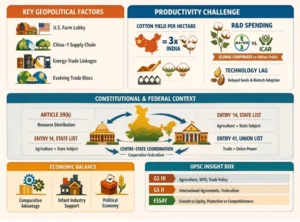
- Entry 14, State List (Seventh Schedule) – Agriculture is a State subject.
- Entry 41, Union List – Trade and commerce with foreign countries.
- Article 39(b) – Distribution of material resources to subserve common good.
- Article 38 – Promotion of welfare and reduction of inequality.
Thus, agricultural trade reform sits at the intersection of Union trade powers and State agricultural jurisdiction.
Policy calibration therefore requires cooperative federalism.
MSP, APMC and Reform Sensitivities
The debate cannot be divorced from:
- MSP-based procurement systems
- APMC-regulated markets
- The political memory of the 2020–21 farm law reforms
States such as:
- Punjab (wheat & paddy)
- Maharashtra (cotton)
- Jammu & Kashmir (apples)
have region-specific exposure patterns.
Trade policy must therefore account for territorial economic diversity.
Political Economy of Protection
Agriculture contributes:
- ~15% of GDP
- Nearly 50% of employment
This asymmetry explains tariff persistence.
Economic theory offers multiple lenses:
| Framework | Insight |
| Comparative Advantage | Efficiency via specialization |
| Infant Industry | Temporary protection justified |
| Political Economy | Concentrated producer interests influence policy |
Tariffs often survive not merely because of economic logic, but because rural stability carries political weight.
The question, however, is not whether protection is legitimate —
but whether it has been accompanied by sustained productivity transformation.
Geopolitics Behind the Grain
Trade in agriculture intersects with broader strategic considerations:
S. Farm Politics
Agriculture is electorally sensitive in several American states. Export markets are politically significant.
China+1 Supply Chain Strategy
India’s calibrated openness signals reliability as an alternative node in diversified supply chains.
Energy–Trade Interlinkages
Recent global developments illustrate how energy purchases and tariff pressures can interact within diplomatic negotiations.
Fragmentation of Multilateralism
With the WTO dispute settlement system weakened, bilateral frameworks have gained prominence.
Agricultural concessions must therefore be understood within this strategic matrix.
The Structural Core: Productivity Gap
Where vulnerability exists — cotton, oilseeds, horticulture — the constraint is largely productivity.
Illustrative comparisons:
- Cotton yield in China ≈ 3–4× India’s
- Apple yield: advanced producers significantly exceed Indian averages
- Research spending gaps between public agricultural institutions and global agribusiness firms
Delayed seed approvals and slow biotechnology adoption have contributed to stagnation in certain segments.
No tariff architecture can sustainably compensate for productivity stagnation.
Long-term farmer welfare depends on:
- Yield enhancement
- Seed reform
- R&D investment
- Supply chain modernisation
Trade exposure tests structural strength — it does not create structural weakness.
UPSC INSIGHT BOX
GS III
- Agriculture pricing & MSP
- Liberalisation and its impact
- WTO architecture
- Food security vs export competitiveness
GS II
- International trade agreements
- Cooperative federalism
- Centre–State relations
Essay Themes
- Growth vs Equity
- Protection vs Competitiveness
- Reform vs Political Stability
- Welfare State in a Globalised Economy
PRELIMS CONCEPTS SNAPSHOT
Most Favoured Nation (MFN)
Non-discrimination principle under WTO; exceptions permitted under FTAs.
Tariff Rate Quota (TRQ)
Specified import quantity at lower tariff; higher tariff beyond quota.
FTA vs Bilateral Trade Arrangement
| FTA | Bilateral Deal |
| Broad tariff elimination | Sector-specific concessions |
| WTO-notified comprehensive agreement | Phased/limited scope |
| Often covers services & investment | Primarily goods-focused initially |
Way Forward: Protection Plus Productivity
- A calibrated pathway may include:
- Substantial increase in agricultural R&D funding
- Regulatory reform in seed and biotechnology frameworks
- Targeted oilseed and pulses missions
- Strategic use of TRQs and safeguard clauses
- Improved FTA utilisation by exporters
- Structured Centre–State consultation mechanisms
- Protection and productivity need not be opposing goals.
They must be sequenced intelligently.
MODEL MAINS QUESTION (20 Marks)
“In the context of evolving global trade dynamics, agricultural protection must transition from price insulation to productivity enhancement.”
Discuss with reference to India’s trade engagement strategy.
PRACTICE MCQs
Q1. With reference to WTO rules, which of the following is correct?
(a) MFN prohibits Free Trade Agreements
(b) TRQs eliminate tariffs beyond quota limits
(c) MFN allows exceptions for WTO-consistent FTAs
(d) All bilateral trade agreements violate WTO norms
Answer: (c)
Q2. Agriculture is primarily a State subject under:
(a) Entry 41, Union List
(b) Entry 14, State List
(c) Article 246(1)
(d) Concurrent List Entry 33
Answer: (b)
Q3. The “Infant Industry” argument primarily justifies:
(a) Permanent protection
(b) Temporary tariff support for developing sectors
(c) Subsidy withdrawal
(d) Complete trade liberalisation
Answer: (b)
Conclusion: Reform Without Retreat
India is no longer a food-deficit nation.
It is a significant agricultural exporter with pockets of structural weakness.
The choice is not between protection and openness.
It is between:
- Static insulation
and - Dynamic competitiveness.
If protection is accompanied by productivity reform, calibrated trade engagement can strengthen rather than weaken Indian agriculture.
The real reform question is therefore not whether India should engage —
but whether its agricultural system is prepared to compete.