
4min read
Let’s cut through the noise. The UPSC syllabus isn’t just big. Staring at the endless list, heart sinking, thinking, Where on do I begin? Most candidates freeze. They drown in more books, endless YouTube marathons, and “magic” strategies. But the real game-changers do something different. They turn to a weapon already in their hands: UPSC previous year questions. This isn’t some secret whispered in coaching corridors but what toppers live by. Past papers don’t just test knowledge but expose UPSC’s mindset. Master them, and you’re not guessing anymore. You’re forecasting.
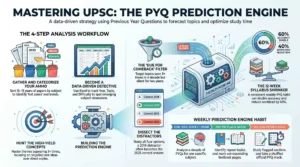
PYQs: An Effective Strategy
To the clueless, Prelims feels like a gamble. A deep UPSC PYQ analysis flips the script. Did you know Buddhist councils resurface every 4–5 years? Or that certain constitutional articles keep making comebacks? Without PYQs, you’re studying in the dark. A winning IAS prelims preparation strategy starts with a map. Tag every question by subject. Colour-code. Spot the hot zones. Then attack them with no distractions, no guilt but some help from a structured analysis.
Step One: Gather Your Ammo
You cant analyse what you don’t have. Get your hands on UPSC previous year papers PDF’s, ideally the last 10 to 15 years. Use authentic sources like official UPSC releases or trusted platforms. But don’t just scroll and forget. Print two sets. Use one for timed mocks, simulate real pressure. Use the second to dissect by subject. Stack all environment questions. Group every Polity MCQ. This sorting is the foundation of UPSC prelims trend analysis. Skip it, and you’ll stay lost in the fog.
Step Two: Become a Question Detective
This is where one implements a data-driven approach. Fire up Excel. Set columns: Year, Subject, Topic, Difficulty, Source. Now, start tagging year after year. After 10 years, patterns leap out. Maybe you spot UPSC’s sudden obsession with Ecology post-2019. Or notice Static Geography fading. These aren’t coincidences. They’re signals. Your compass. Point your prep where it actually matters.
Step Three: Hunt the High-Yield Topics
Here’s the nightmare: grinding low-yield content while high-frequency gems slip by. PYQs end that fear. Build a master list, every concept that’s shown up 3+ times in a decade. National Parks paired with wildlife. Parliamentary majorities. RBI’s monetary tools. Own these. But go deeper; spot indirect repeats. UPSC rarely copies questions. But they love recycling core ideas. Find those recurring concepts. That’s where an evidence based preparation comes to frame.
Step Four: Pick the Right PYQ Companion
Ideally, you analyse yourself. But time is tight. That’s where a smart best PYQ book for UPSC prelims steps in. A great one does four things: organises by topic, explains all options (not just the right one), cites sources, and shows visual trends. Try Vivek Bansal or Disha’s 25-year compilation. But never outsource your brain. Use books to confirm your findings and not replace your thinking.
CSAT Previous Year Questions
CSAT previous-year questions are more predictable than GS. Analyse five years. Comprehension, Logical Reasoning, Basic Numerical’s, stick to a range. Certain types return like clockwork: calendar puzzles, syllogisms, blood relations. One focused weekend on CSAT PYQs beats a month of scattered practice.
Build a Weekly PYQ Habit
Here’s your battle plan:
Mon–Wed: Pick one subject. Crush all its PYQs from the last decade. For every wrong answer, dig into why.
Thu: Build your “Repeat Topics” list. Highlight anything appearing in more than 3 years.
Fri: Match those topics to your textbooks. Mark pages with sticky notes.
Sat: Revise only those flagged sections.
Sun: Take a mock using shuffled official PYQs.
Do this for 12 weeks. Your syllabus shrinks by 40%. Accuracy? Doubles.
Even with PYQs, aspirants crash. Why?
One: Solving only year-by-year. Start topic-wise, then shift to chronological.
Two: Ignoring wrong options. A distractor in 2019 could be the answer in 2025. Study all four.
Three: Hoarding PDFs and doing nothing. Downloading without action is just procrastination in disguise.
Four: Believing “nothing repeats”. Myth. Concepts? Themes? They do. Trust the data.
Build Your Prediction Engine
How do you really predict? Create a “Prediction List” of 50 high-probability topics. Filter with precision:
Appeared 3+ times in 10 years but not in the last two. It’s due.
Hot current affairs with strong static roots.
New NCERT additions never yet tested.
For 2025, this method flags: Critical Mineral Blocks, Forest Rights Act amendments, recent SC federalism rulings. This isn’t guesswork.
Conclusion
The UPSC syllabus is an ocean. You can’t drink it all. But UPSC previous year questions? They’re your compass. They won’t promise every predicted topic appears. But they will save you from wasting months on dead ends. Every topper has done this grind. Now it’s your turn. Download those papers. Open your notebook. Start connecting the dots. It’s hidden in the questions of the past.