
17min read
Introduction
In every democracy, the fight against corruption presents a fundamental dilemma. Can the State be empowered enough to pursue economic offenders without becoming powerful enough to threaten individual liberty? In contemporary India, few institutions embody this tension more vividly than the Enforcement Directorate (ED).
The Enforcement Directorate has emerged as one of India’s most visible investigative agencies in recent years. Whether it is high-profile corruption cases, money laundering investigations, economic offences, or fugitive offenders, the ED frequently occupies national headlines. For UPSC aspirants, understanding the Enforcement Directorate is important not only from the perspective of Polity and Governance but also from Internal Security, Economy, Ethics and Current Affairs.
The ED lies at the intersection of financial regulation, criminal investigation, anti-corruption efforts and economic security, making it one of the most consequential institutions in India’s governance framework.
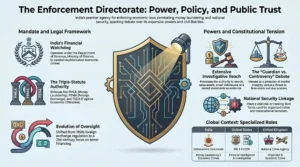
What is the Enforcement Directorate?
The Enforcement Directorate (ED), officially known as the Directorate of Enforcement, is a multi-disciplinary organization functioning under the Department of Revenue, Ministry of Finance. It is responsible for enforcing laws relating to money laundering, foreign exchange violations and economic offences.
The agency traces its origins to 1956 when an “Enforcement Unit” was established to deal with violations of foreign exchange laws. Over time, its mandate expanded significantly, especially after the enactment of the Prevention of Money Laundering Act (PMLA), 2002.
Why Does the Enforcement Directorate Matter?
At first glance, the Enforcement Directorate appears to be just another investigative agency tasked with probing money laundering and economic offences. However, viewing the ED solely through this lens would be to underestimate its significance in contemporary India.
Few institutions today occupy as strategic a position within India’s governance architecture as the Enforcement Directorate. The debates surrounding the ED are rarely confined to financial crime alone. They often touch upon some of the most fundamental questions confronting a modern democracy: How should the State combat corruption? How can economic integrity be protected in a globalised world? How should individual liberty be balanced against the demands of enforcement? And where should the line be drawn between institutional power and constitutional accountability?
The importance of the ED lies precisely in the fact that it stands at the intersection of these questions.
Rule of Law: Ensuring Accountability in the Economic Sphere
In any constitutional democracy, the rule of law demands that wealth, influence and political power should not place individuals above legal scrutiny. By investigating proceeds of crime and tracing illicit financial transactions, the ED seeks to ensure that economic offences are not insulated from accountability. In this sense, the agency serves as an instrument through which the state reinforces the principle that no person is beyond the reach of law.
Economic Governance: Protecting the Integrity of Markets
A modern economy thrives on transparency, investor confidence and regulatory compliance. Money laundering and illicit financial flows distort markets, weaken institutions and undermine economic stability. By combating such activities, the ED contributes to safeguarding the credibility of India’s financial system and strengthening the foundations of sound economic governance.
Federalism: Operating at the Union–State Interface
Many investigations undertaken by the ED originate from offences first detected by State Police agencies or other state-level authorities. Consequently, the agency frequently operates at the intersection of Union and State jurisdictions. This makes the ED a recurring subject in debates concerning cooperative federalism, institutional coordination and the distribution of powers within India’s constitutional framework.
Civil Liberties: Balancing Enforcement and Freedom
The powers available to the ED under the Prevention of Money Laundering Act have generated important debates regarding due process, personal liberty and constitutional safeguards. Supporters argue that strong powers are indispensable for combating sophisticated financial crime, while critics emphasise the need for robust protections against arbitrary action. The ED therefore occupies a central place in the larger democratic conversation on how liberty and enforcement should be balanced.
Anti-Corruption Framework: A Key Institutional Pillar
Corruption and financial crime rarely operate in isolation. Alongside institutions such as the CBI, Lokpal, Central Vigilance Commission and Income Tax Department, the ED forms a crucial component of India’s anti-corruption architecture. Its role extends beyond investigation; it contributes to strengthening public accountability and protecting the integrity of governance institutions.
National Security: Following the Money Trail
In the twenty-first century, threats to national security are increasingly financial in nature. Terrorist organisations, organised crime syndicates and transnational criminal networks often rely upon complex funding mechanisms to sustain their activities. Tracking the movement of illicit funds has therefore become as important as tracking the perpetrators themselves. Through its financial investigations, the ED contributes to the broader objective of safeguarding national security.
The Bigger Picture
The Enforcement Directorate is therefore far more than a financial investigation agency. It is an institution through which the Indian State seeks to protect economic integrity, uphold the rule of law, combat corruption, address security threats and maintain public confidence in governance.
The continuing debate surrounding the ED ultimately reflects a challenge faced by every modern democracy: how to equip the State with sufficient powers to combat increasingly sophisticated economic crime while ensuring that those powers remain accountable to constitutional principles. Understanding this tension is essential to understanding not only the ED, but also the evolving nature of governance in contemporary India.
To understand why the ED occupies such a central position in India’s governance framework today, it is necessary to examine how the institution evolved in response to changing economic realities and emerging forms of financial crime.
Evolution of the ED
| Year | Development |
| 1956 | Enforcement Unit established under the Department of Economic Affairs |
| 1957 | Renamed as Enforcement Directorate |
| 1973 | Enforcement of Foreign Exchange Regulation Act (FERA) |
| 1991 | Economic Liberalisation and growing integration with global markets |
| 1999 | FEMA replaced FERA |
| 2002 | Prevention of Money Laundering Act enacted |
| 2005 | ED became the primary agency for enforcing PMLA |
| 2018 | Fugitive Economic Offenders Act enacted |
| Present | Focus on money laundering, terror financing and cross-border financial crime |
Understanding the Evolution
The evolution of the ED mirrors the evolution of the Indian economy itself. In the pre-liberalisation era, economic offences largely revolved around foreign exchange violations. However, globalisation, digital finance, offshore banking, shell companies and international capital flows have fundamentally transformed the nature of economic crime. Consequently, India’s enforcement architecture has had to evolve from merely regulating foreign exchange to combating sophisticated financial crimes operating across multiple jurisdictions.
Legal Framework Governing the ED
-
Prevention of Money Laundering Act (PMLA), 2002
PMLA seeks to prevent money laundering and confiscate proceeds of crime. Under this law, the ED investigates offences linked to scheduled crimes, traces illegally acquired assets, attaches properties and prosecutes offenders before Special Courts.
-
Foreign Exchange Management Act (FEMA), 1999
FEMA regulates foreign exchange transactions and cross-border financial dealings. Unlike PMLA, FEMA is a civil law. The ED investigates violations, adjudicates cases and imposes penalties.
-
Fugitive Economic Offenders Act (FEOA), 2018
This law enables attachment and confiscation of properties belonging to economic offenders who evade Indian courts by remaining abroad.
Organisational Structure
The ED is headed by the Director of Enforcement, an officer of the rank of Additional Secretary to the Government of India. The Director is assisted by Special Directors, Additional Directors, Joint Directors, Deputy Directors, Assistant Directors and Enforcement Officers. The headquarters is located in New Delhi, with zonal and regional offices across the country.
Major Powers of the Enforcement Directorate
Under the PMLA, the ED possesses extensive investigative powers.
Search and Seizure
The agency can search premises, seize documents and freeze assets suspected to be linked to money laundering.
Arrest
The ED can arrest individuals involved in money laundering after recording reasons for such action.
Property Attachment
Properties suspected to be proceeds of crime may be provisionally attached and later confiscated upon judicial approval.
Summons and Examination
The agency can summon individuals and record statements under Section 50 of the PMLA. Such statements have evidentiary value.
Why Has the ED Become Increasingly Important?
The growing prominence of the ED is not merely a result of expanding legal powers. It reflects broader transformations in the nature of economic crime.
Rise of Complex Financial Crime
Traditional corruption often involved cash transactions and local networks. Modern economic crime increasingly operates through shell companies, offshore accounts, layered transactions, cryptocurrencies and trade-based money laundering mechanisms. Investigating such crimes requires specialised financial expertise and sophisticated forensic capabilities.
Globalisation and Economic Security
In a highly interconnected global economy, illicit funds can move across jurisdictions within seconds. Financial crimes today are rarely confined within national borders. The ED therefore serves as an important instrument for protecting India’s financial sovereignty and economic security.
Terror Financing and Organised Crime
Money laundering networks often overlap with terrorism financing, narcotics trafficking and organised criminal enterprises. Consequently, tracing financial transactions is frequently more effective than merely tracking individual offenders.
Protecting Public Resources
Economic offences divert resources away from productive economic activity, undermine investor confidence and weaken public trust in institutions. Effective enforcement is therefore not merely a law-and-order issue but also a developmental imperative.
ED at a Glance: The Expanding Challenge of Financial Crime
| Indicator | Emerging Trend |
| PMLA Investigations | Sharp increase over the past decade as financial crimes have become more sophisticated and interconnected. |
| Assets Attached | Several lakh crore rupees worth of assets have been provisionally attached under anti-money laundering provisions. |
| International Cooperation | Growing engagement with foreign jurisdictions, international agencies and treaty-based mechanisms. |
| Nature of Financial Crime | Increasingly transnational, technology-driven and dependent on complex financial networks. |
| Methods Used by Offenders | Shell companies, offshore accounts, layered transactions, trade-based money laundering and digital assets. |
| Security Linkages | Greater overlap between money laundering, organised crime, narcotics trafficking and terror financing. |
Why This Matters
The growing scale, sophistication and transnational nature of financial crime partly explains the increasing prominence of the Enforcement Directorate in India’s governance framework. As economic offences evolve beyond traditional forms of corruption, investigative agencies require greater financial expertise, international cooperation and technological capability to effectively trace illicit funds and enforce the law.
Core Functions and Contributions of the Enforcement Directorate
The significance of the Enforcement Directorate ultimately lies not in the powers it possesses, but in the functions it performs. As India’s principal agency for combating money laundering and enforcing key financial laws, the ED plays a crucial role in preserving the integrity of the country’s economic and governance framework.
Investigating Money Laundering and Financial Crime
The ED serves as the primary agency responsible for enforcing the Prevention of Money Laundering Act (PMLA). By tracing the proceeds of crime and uncovering complex financial networks, it seeks to prevent illicit wealth from being integrated into the formal economy. In doing so, the agency addresses a wide range of offences that often serve as the financial backbone of corruption, organised crime and illegal economic activity.
Recovering and Confiscating Illicit Assets
A distinctive feature of the ED’s mandate is its ability to identify, attach and facilitate the confiscation of assets derived from criminal activity. This reflects an important principle of modern law enforcement: crime should not remain profitable. By targeting illegally acquired wealth, the agency seeks not merely to punish offenders but also to deprive criminal enterprises of their economic foundations.
Enforcing Foreign Exchange Laws
Through the Foreign Exchange Management Act (FEMA), the ED monitors and investigates violations relating to foreign exchange transactions and cross-border financial dealings. In an increasingly globalised economy, such oversight is essential for maintaining financial stability and ensuring compliance with India’s regulatory framework.
Facilitating International Cooperation
Financial crimes rarely respect national boundaries. Money laundering networks, offshore entities and transnational criminal organisations often operate across multiple jurisdictions. The ED therefore works closely with foreign governments, international agencies and treaty-based mechanisms to investigate cross-border financial crimes and recover assets located abroad.
Supporting Economic Governance
Beyond individual investigations, the ED contributes to the broader objective of promoting transparency, financial accountability and regulatory compliance. By deterring illicit financial activity and strengthening trust in economic institutions, the agency plays an important role in safeguarding the credibility of India’s financial system.
Upholding Public Confidence in Institutions
Economic offences erode public trust in governance and weaken faith in the fairness of the system. By pursuing cases involving financial misconduct and unlawful enrichment, the ED contributes to the larger goal of reinforcing accountability within public and private institutions alike.
A Broader Institutional Role
The Enforcement Directorate is therefore not merely an investigative body. It is an institution that helps protect the integrity of India’s economic system, supports the rule of law and strengthens the State’s capacity to respond to increasingly sophisticated financial crimes. Its importance lies as much in preserving public confidence in governance as in enforcing the law itself.
Constitutional Dimensions of the ED
The debate surrounding the ED is ultimately a constitutional debate rather than merely an administrative one.
Article 14: Equality Before Law
The legitimacy of any investigative agency depends upon impartial enforcement. Any perception of selective investigation can raise concerns regarding equality before law.
Article 21: Personal Liberty and Due Process
While combating economic crime is essential, investigative processes must also respect personal liberty, procedural fairness and constitutional safeguards.
Federalism
Since many predicate offences originate from investigations conducted by State Police agencies, ED interventions occasionally generate Centre-State tensions, raising important federal questions.
Rule of Law
The effectiveness of anti-corruption institutions ultimately depends not merely on their powers but also on their adherence to constitutional norms, judicial oversight and institutional accountability.
Major Criticisms and Concerns
Despite its importance, the Enforcement Directorate remains one of India’s most debated institutions. The expansion of its powers has generated intense discussions among policymakers, constitutional experts, political parties and civil society.
Allegations of Political Misuse
Opposition parties have frequently alleged selective targeting of political opponents. While governments have defended the agency’s actions as lawful investigations, critics argue that perceptions of political bias can affect public trust in institutions.
Low Conviction Rates
Critics point out that although the number of investigations and attached assets has increased substantially over the years, convictions have not always kept pace. This raises important questions regarding the relationship between investigation, prosecution and judicial outcomes.
Expanding Powers
The ED possesses extensive powers relating to search, seizure, arrest and attachment of property under the PMLA. Several legal scholars have argued that such powers require strong procedural safeguards to prevent misuse.
Federalism Concerns
Since many ED investigations originate from offences being investigated by State Police agencies, tensions sometimes emerge between the Union and State governments. This has led to wider debates regarding cooperative federalism and the distribution of investigative powers in India’s constitutional framework.
The Great Debate: Is the ED Too Powerful?
The controversy surrounding the ED is often framed as a broader debate between effective enforcement and constitutional accountability.
Viewpoint I: Strong Powers Are Necessary
Supporters of the current framework argue that:
- Modern financial crimes are highly sophisticated.
- Money laundering networks operate across multiple jurisdictions.
- Evidence can be concealed or destroyed quickly.
- Terror financing and organised crime require robust enforcement mechanisms.
- Weak investigative powers may allow economic offenders to evade accountability.
From this perspective, empowering agencies like the ED is essential for protecting national economic security.
Viewpoint II: Strong Powers Require Strong Safeguards
Critics contend that:
- Extraordinary powers should be accompanied by extraordinary accountability.
- Long investigations may become punitive even before conviction.
- Extensive powers of arrest and attachment can affect civil liberties.
- Public confidence depends upon visible institutional neutrality.
According to this view, the legitimacy of enforcement is strengthened not merely by effectiveness but also by fairness.
A Balanced Perspective
The real question is not whether the ED should be powerful. Rather, it is whether adequate safeguards exist to ensure that such power is exercised transparently, proportionately and in accordance with constitutional principles.
Judicial Perspective
The judiciary has played a crucial role in defining the contours of the ED’s powers and responsibilities.
Vijay Madanlal Choudhary v. Union of India (2022)
This landmark judgment represents one of the most significant judicial pronouncements on India’s anti-money laundering framework.
The Supreme Court largely upheld the constitutional validity of key provisions of the Prevention of Money Laundering Act.
Why Was the Judgment Significant?
The Court:
- Recognised money laundering as a serious threat to the economy.
- Upheld major investigative powers available under the PMLA.
- Endorsed the special legal framework created to combat financial crimes.
- Strengthened the legal foundation of the ED’s operations.
Continuing Debate
While supporters viewed the judgment as essential for strengthening anti-money laundering efforts, critics expressed concerns regarding due process protections, evidentiary standards and safeguards against potential misuse.
Consequently, the judgment remains a central reference point in contemporary discussions on economic governance and civil liberties.
How Do Other Democracies Combat Financial Crime?
The challenge of combating money laundering is not unique to India.
| Country | Principal Institution |
| India | Enforcement Directorate |
| United States | FBI, FinCEN and Department of Justice |
| United Kingdom | National Crime Agency |
| Singapore | Corrupt Practices Investigation Bureau |
| Hong Kong | Independent Commission Against Corruption (ICAC) |
Lessons for India
Several international experiences highlight the importance of:
- Strong inter-agency coordination.
- Professional financial investigation capabilities.
- Speedy prosecution and adjudication.
- Transparent institutional processes.
- High conviction rates backed by quality investigations.
The effectiveness of an investigative agency ultimately depends not merely on powers but on institutional credibility and professional competence.
ED and India’s Developmental Aspirations
The significance of the ED extends beyond criminal investigations.
As India seeks to become a developed economy by 2047, financial integrity will become increasingly important.
Money laundering affects:
- Investor confidence.
- Ease of doing business.
- Tax compliance.
- Financial stability.
- Public trust in institutions.
Therefore, strengthening mechanisms to combat illicit financial flows is not merely a governance objective but also a developmental imperative.
Think Box
Can a democracy effectively combat sophisticated economic crime without granting extraordinary powers to investigative agencies? If such powers are necessary, what institutional safeguards should exist to prevent their misuse?
This question lies at the heart of the contemporary debate surrounding the Enforcement Directorate.
UPSC Insight
Prelims Focus Areas
- Ministry under which ED functions.
- Difference between FEMA and PMLA.
- Meaning of proceeds of crime.
- Fugitive Economic Offenders Act.
- Scheduled offences under PMLA.
- Directorate of Enforcement’s role under various statutes.
Mains Focus Areas
- Balance between economic security and civil liberties.
- Accountability of investigative agencies.
- Constitutional dimensions of anti-corruption institutions.
- Federalism concerns in financial investigations.
- Role of judicial oversight in democratic governance.
Essay Themes
- Power and accountability in a democracy.
- Corruption and economic development.
- Rule of law as the foundation of good governance.
- Balancing liberty and security in modern states.
Way Forward
-
Strengthening Institutional Independence
Public confidence in investigative agencies depends upon their ability to function free from political influence.
-
Enhancing Procedural Safeguards
Strong enforcement should be accompanied by equally robust protections for constitutional rights and due process.
-
Faster Judicial Resolution
Special courts dealing with money laundering cases should be adequately staffed to ensure timely adjudication.
-
Capacity Building
Financial crimes increasingly require expertise in forensic accounting, cyber investigations, artificial intelligence and international financial networks.
-
Greater Transparency and Accountability
Periodic public reporting, parliamentary scrutiny and institutional oversight can strengthen legitimacy and trust.
Conclusion
The debate surrounding the Enforcement Directorate is ultimately not about a single institution. It is about the larger question of how democratic societies balance liberty with security, accountability with efficiency, and constitutionalism with enforcement.
As India emerges as one of the world’s leading economies, the need for strong institutions capable of combating financial crime will only increase. Yet the true measure of success will not lie merely in the number of raids conducted, assets attached or investigations initiated. It will lie in ensuring that the pursuit of justice remains firmly anchored in constitutional values, transparency and the rule of law.
A mature democracy requires institutions that are both powerful and accountable. The future challenge for India is not choosing between these principles, but successfully reconciling them.
Ultimately, the debate surrounding the Enforcement Directorate is also a reflection of a larger challenge confronting modern democracies—how to ensure that the power necessary to uphold justice never exceeds the constitutional limits designed to protect freedom.
Tailpiece
“The strength of a democratic institution is measured not merely by the authority it possesses, but by the public trust it inspires while exercising that authority.”